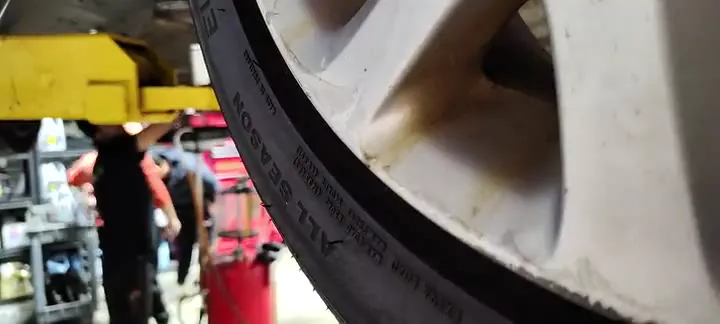
Where to find your size
Your vehicle's correct size is on the placard on the driver's door jamb (sometimes in the glove box or fuel door), and in the owner's manual. The size on your current tires is printed on the sidewall, but it's only correct if the previous tires were the right ones.
225: Width in millimetres
The first number is the tire's width in millimetres, from sidewall to sidewall. A 225 tire is 225 mm wide.
65: Aspect ratio
The number after the slash is the sidewall height as a percentage of the width. In 225/65, the sidewall is 65% of 225 mm, or about 146 mm. A lower number means a shorter sidewall and usually a firmer ride.
R17: Construction and rim diameter
R means radial construction, which almost every modern tire uses. The number after it is the rim diameter in inches; this one fits a 17-inch wheel.
102H: Load index and speed rating
The load index (102) is how much weight each tire can carry: 102 means 850 kg per tire. The letter (H) is the speed rating: H is rated to 210 km/h, T to 190 km/h, V to 240 km/h.
Never fit a tire with a lower load index than your placard specifies. A lower speed rating is sometimes accepted on winter tires, but check your manual first.
P-metric vs LT
Some sizes start with a letter. P (or no letter) is a passenger tire. LT is a light-truck tire with stiffer construction and a load range (C, D or E) for towing and heavy payloads. If your pickup or van's placard calls for LT tires, stay with LT; switching to passenger tires can reduce safe load capacity. More on truck sizes on our brands and prices page.
Other markings worth knowing
Beyond the size, the sidewall tells you:
- The DOT code: its last four digits are the week and year the tire was made.
- The three-peak mountain-snowflake symbol, if the tire is winter-rated.
- Maximum pressure: this is not your operating pressure; use the door placard instead.
- XL or Extra Load, meaning a higher load capacity than the standard version of that size.
What to tell a shop for a price
Give the full size including the load index and speed rating (for example 225/65R17 102H), your vehicle's year, make and model, and how you drive (city, highway, towing). A photo of the sidewall works too. With that, we can quote installed prices in each tier.